The valley woke before the camp did. Not with light, but sound.
First came the river.
Somewhere below the limestone cliffs, the current pushed beneath its thin skin of ice, groaning and knocking against the frozen edges. A fox barked once in the distance. Then, beyond the western ridge, a mammoth called. The sound rolled through the valley like distant thunder.
Another answered.
Then another.
Finally came the ravens, quarrelling loudly over some mystery that seemed important only to them.
Tarek opened his eyes and cold immediately found him. He pulled the hide around his shoulders, and for a moment, he did not remember where he was. The embers had almost died, leaving only a dull red eyes beneath white ash, waiting for someone to wake it. Then he remembered. The hunt. Oruk. And the spear.
The words came ringing back to him, clear as though they had been spoken only moments ago.
`Tomorrow, Oruk will leave.‘
But today was yesterday’s tomorrow. And Oruk would leave.
A sudden thought seized him.
‘Had he already gone?‘
The possibility struck him with such force that Tarek sat bolt upright, his breath caught in his throat.
He looked around, but the old hunter was nowhere to be seen.
Then another thought came to him. He would not leave before the hunt. Not without a word. He must have gone to check the traps along the edge of the camp.
Tarek rose to his feet and made his way toward the cave. His spear was still there, waiting where he had left it.
Dawn had not yet reached the valley.
The darkness above the eastern mountains began to thin. Grey spread slowly across the sky, swallowing the last stars. The aurora faded into a pale green veil, and the first light touched the highest peaks without reaching the valley floor.
When Tarek returned, Oruk was already beside his weathered boulder, hunched over the dying embers and rubbing his hands together for warmth. His breath drifted upward in pale clouds, dissolving into the cold air. A seasoned spear leaned against the stone beside him, its worn shaft darkened by years of use.
Tarek looked down at his own weapon. It was not much. The spear was shorter than those carried by the adult hunters, barely taller than himself. No matter how carefully he had worked it, it still looked less like a hunter’s weapon than a child’s poor imitation of one.
The old hunter glanced over and said, “You came.”
Tarek nodded, wondering if Oruk had only been teasing him last night.
Oruk’s eyes moved from the spear to Tarek, then back to the spear again. One eyebrow rose slightly.
Tarek’s stomach tightened.
Oruk reached out and tapped the shaft with one finger and said, “I was hoping you would bring a spear.”
Tarek looked offended and replied, “This is a spear.”
Oruk considered it, “Ah.”
Kanu, one of the twin hunters, passed by and gave a low chuckle.
“Careful with that twig, kid,” he said, “You may hurt yourself before you manage to hurt anything else.”
Taruk, the other twin, pinched the shaft between two fingers and asked, “I’ve seen longer walking sticks.”
Tarek lowered his eyes. Suddenly, the spear felt smaller in his hands, yet somehow heavier than before.
Oruk took the spear and slowly turned it in his hands. His fingers ran along the young, bare branch, searching for cracks and weak places. He bent it gently, then examined the crooked stone point in silence.
Tarek watched his face, and Oruk’s eyes narrowed.
He ran his thumb carefully along the edge and asked, “Did you make this?”
“I did.” Tarek replied.
“Who sharpened the stone?”
“I did.”
Oruk nodded solemnly, “I can see that.”
Tarek frowned, “It cuts fine.”
“Yes, the point is ugly, but edges are sharp.”
Oruk handed the spear back.
“Is it good enough?” asked Tarek hesitantly.
“Good enough for learning.” Oruk looked toward the eastern ridge and replied, “And today you’ll learn.”
Tarek felt embarrassed and strangely proud anyway.
Behind them, the camp was beginning to stir.
The embers were fed dried chips, then a branch at a time, until the fire climbed back to life.
Orange light spilled across the camp, catching on fur, bone and weathered skin as people emerged from the cave and shook the night’s cold from their bodies. They wore clothes made for survival, not appearance. There were no trousers, no woven shirts, nothing that divided the body into neat pieces. Most wore a single hide, patched and softened through years of use, sometimes carrying pieces of skins worn by those who had died before them. A single hide was wrapped around the waist and between the legs and held by a narrow strip of twisted sinew or leather, leaving the legs bare for climbing, running and crouching. The women pulled longer hides around their waists and across their shoulders when the wind rose, while children disappeared beneath whatever pieces of fur had been left for them, some so large that the edges dragged through the snow. Smoke had darkened the older hides, grease had softened them, and years of rain and frost had left their edges uneven. Here and there, a tooth, feather or polished bone hung from a cord, catching the firelight for an instant before disappearing again into the brown, grey and white of the morning.
The camp simply changed its rhythm. Sleeping bodies became moving bodies. Hunters emerged from the cave carrying bundles of spear shafts. Spears were checked. Knots were tightened. Stones were tested. But not all the hunters would go for the hunt. Many stayed behind to guard the camp.
Oruk stood slowly. His knees protested. He ignored them anyway.
“Time.”
There were seven of them.
Oruk was the oldest.
Urak, broad-shouldered and quiet, carried the longest spear. The twins, Taruk and Kanu, followed with shorter spears and coils of twisted plant fibre. Toran, the fastest, carried a stone axe. Xana and Luma were the only women who joined them. Both were experienced hunters, each carrying a spear and a small hide pouch.
And Tarek, the youngest.
The others looked at him. Not unkindly. But carefully.
Taruk crouched beside him and said, “Stay behind us.”
Tarek nodded.
Xana added, “Do not run toward the animals.”
“Do not run away from us,” Urak added.
Tarek nodded again.
Luma looked at him, “Do not throw your spear unless Oruk tells you.”
Tarek nodded
The sound rolled through the valley like distant thunder, and Tarek turned toward the valley.
The sun had finally begun to rise. Its first light touched the highest peaks. The mountains changed from black to violet, then slowly to grey. The valley below remained in shadow. The frozen river wound through the landscape like a pale scar. Beyond it, the grasslands stretched toward the western ridge. And there, far away, dark shapes appeared through the morning mist.
At first, Tarek could not tell what they were. Then one of the shapes moved. A massive head rose above the mist. Another followed.
Mammoths. The herd.
Tarek’s heart began to beat faster.
Oruk watched the herd, then looked at the boy and asked, “Ready?”
Tarek tightened his grip on the spear and replied, “Yes.”
Oruk smiled, “No.”
Tarek frowned.
Oruk stepped forward, “Nobody is ready.”
Then he started walking. The others followed.
Tarek hesitated only for a moment before joining them.
Behind them, the camp was already shrinking into the morning.
Oruk did not look back once and kept walking, while Tarek kept looking back every few steps. Soon, they crossed the mark that had always been the limit of Tarek’s world.
Tarek caught up and asked, “Oruk?”
The old hunter looked at him and asked, “Yes?”
“Why didn’t you look back?”
Oruk’s eyes remained on the trail ahead and replied, “Because I know what is behind me.”
He glanced toward the mountains and continued, “But I don’t know what’s ahead.”
They walked on.
Their footprints appeared one after another in the frost. Eight hunters. Eight shadows.
The light was strange that morning. The sun had risen without the warmth, and even the ravens seemed restless. Oruk had noticed the sky before the others, but said nothing. There were days when the world behaved differently, and old hunters learned not to ask it why.
Then, the first rays of sunlight finally reached the valley floor, and ahead lay the tundra.
It rolled beneath the pale morning like a frozen sea, broken by low ridges, shallow gullies, patches of wind-scoured yellow grass, and scattered boulders left by ancient glaciers. Frozen pools reflected the pale sky, while distant stands of dark pine stood against the horizon. Somewhere beyond the next few rises, the mammoth herd moved, invisible now. But the ground remembered them.
The hunters crossed in silence. Beyond the river stretched endless white. Tiny willow branches poked through the snow. Their tips were broken.
“The wind?” asked Tarek.
“The deer.” replied Toran.
“They ate sticks?”
Toran snapped off a twig. Fresh green shone inside.
“They bit, and they will return.”
The frozen river groaned beneath its own weight.
The wind erased tracks almost as quickly as feet made them, flattening the frost-white grass into long, silver waves. But by the time they reached the open tundra, the wind had shifted.
Oruk stopped, and the party stopped with him. He lifted a handful of loose grass and let it fall. The wind, sweeping down from the mountains, caught it immediately. It scattered eastward.
“Good,” said Oruk, looking toward the silhouettes of mammoths and then back at the hunters. “The wind is hunting for us.”
The hunters began moving again.
Nothing grew tall enough to hide a person. That was why hunters learned to become part of the land. They never walked against the skyline. They never hurried. They crossed ridges on their knees and elbows. They used boulders, folds in the earth, patches of willow scrub and frozen streambeds the way wolves used shadows.
Tarek copied every movement. Not because anyone told him. Because everyone else moved the same way.
By midday, they found the first prints. Huge circles pressed deep into frozen earth.
Their dung steamed faintly where the sun had touched it.
Toran knelt beside one and said, “They’re close.”
Excitement spread quickly. The hunters quickened their pace. They did not walk in a straight line any more.
Oruk led them in a wide arc across the tundra, keeping low whenever the land rose. They used every fold in the ground, every cluster of dwarf birch, every ridge of wind-packed snow. The mammoths were still far away, but the herd had already noticed something.
Their ears moved. Their trunks lifted. The largest animals turned toward the wind.
Oruk immediately lowered himself. The others followed. For several moments, nobody moved.
The mammoths stood listening. One of the calves pressed against its mother. A bull swung its head toward the hunters.
Tarek’s heart hammered. Oruk touched two fingers to his lips.
Wait.
The wind strengthened. Snow began blowing across the tundra. The mammoths relaxed. Only then did the hunters move again.
They were not chasing the herd. They were shaping it.
That was the difference.
The mammoths were moving south, toward grass and water, unaware that the hunters had prepared a different destination for them.
Months earlier, when the ground was still soft beneath the summer sun, they had dug a long trench in the narrow passage between two low ridges. At the bottom, they had planted sharpened wooden stakes, then covered the opening with branches, grass, and earth. From a distance, the trap was invisible, though it was not deep enough to stop every mammoth.
But they did not need all, but one.
One mammoth meant meat for months. Hide for shelters. Fat for lamps through the longest nights.
The trench never moved. The mammoths did.
And mammoths were not stupid, as some believed. They would never willingly walk toward a strange opening in the earth. So the hunters had to make the landscape itself drive them there.
Sometimes, the trap waited an entire year before the valley offered another chance.
Oruk turned to the two women and said, “Go.”
They nodded. They carried no torches and no unnecessary weapons. Their task was not to hunt. They disappeared into the wind, into a shallow depression and began moving toward the trap.
Then Oruk turned to the others and nodded.
The hunters separated. One climbed a ridge overlooking the valley. Another moved toward a line of rocks. One disappeared into the grass. The remaining hunters spread themselves in a wide arc.
They were not surrounding the mammoths.
Not yet.
While others took their positions, Oruk remained with Tarek. They crawled through waist-high grass glazed with frost. The earth smelled of wet moss beneath the snow.
Tarek’s fingers had long since become numb. Still, he refused to complain. Oruk noticed. He noticed everything.
“Move them, boy. Keep them alive,” he said, rubbing his own hands.
Tarek looked at him.
“Cold takes what you do not use.”
Between two low ridges, barely fifty paces away, stood the heart of the herd. Steam drifted upward from their backs. They looked like great, wandering hills of colours, their shaggy coats flowing from the darkness of ebony through rich brown and ginger to the pale glow of winter gold. But they were not alone.
Reindeer moved with them, a living sea of narrow legs and antlered shadows flowing through the tundra grass. They were not part of the same herd, yet in winter they shared the same grass, the same wind, the same danger. Where the mammoths went, the reindeer often followed at a distance, picking at the grass the larger beasts exposed, trusting the great bodies to break the snow before them.
The sky was pale, veiled with thin cloud, and the light lay flat across the tundra, making every hollow and rise visible. Out here, the land did not hide mistakes. It punished them.
Then the wind shifted. Oruk immediately lowered himself.
“Down.”
The old hunter lowered himself until his chest touched the frozen earth. Tarek copied him. The herd was still unaware.
For a moment. Then one mammoth lifted its trunk.
Oruk froze.
Tarek froze.
The animal stood motionless. Its trunk moved through the air. The wind must have carried the human scent.
Oruk watched the mammoth’s ears.
Nothing.
Then the animal lowered its trunk. Tarek exhaled.
A low rumble rolled through them.
Not an alarm. Conversation.
The great female spread her hind legs. Another female stepped beside her. The herd quietly tightened around them.
“What are they doing?” Tarek whispered.
Oruk’s eyes widened, “They’re making a wall.”
Another deep rumble. Then another. The entire herd seemed to breathe together.
Minutes passed. No one moved.
Then—
A tiny shape appeared beneath the mother.
Wet. Shaking. Alive.
The calf collapsed immediately into the snow. Its mother touched it gently with her trunk. Another female drove away curious yearlings. The circle tightened.
Tarek forgot to breathe, “I’ve never…”
Neither had Oruk. Not this close. The calf struggled. Fell. Rose again. Its legs trembled beneath its own weight, and the mother waited. Its fur was blonde and damp in places.
The hunt disappeared from Tarek’s mind. The tundra seemed to hold its breath.
The calf collapsed into the snow.
Tarek held his breath.
The mother nudged it.
It tried again. Its legs shook beneath it, folded, and almost gave way. Then, stubbornly, impossibly, the calf stood.
The old hunter’s expression had changed. The amusement was gone. He was calculating.
The calf was a problem. A newborn could slow the herd. But it could also make the adults more dangerous. The mothers would fight. The bulls would become aggressive. The herd would close around the weakest.
“We shouldn’t hunt them,” said Tarek.
The boy had seen the mammoth herd as food. Now he saw a family. Oruk placed a hand on his shoulder.
“We hunt because we must eat,” said Oruk.
Tarek looked toward the newborn and requested, “Not that one.”
“No,” Oruk’s voice softened, “Never a young one.”
Tarek whispered, “Will it keep up?”
Oruk watched the herd and replied, “That is what we are about to find out.”
The wind was strengthening. That was good. A distant whistle drifted across the valley.
Xana.
The trench had survived the weight of the snow.
Oruk stood. His expression changed. Wonder gave way to purpose.
Oruk raised his arm and shouted.
The hunt began.
The mammoths saw the movement and hesitated. For a moment, nothing happened. The great animals stood with their heads raised, listening.
Then a bull gave a deep, warning rumble.
The sound passed through the herd. The elders rumbled and turned, not fleeing yet, but tightening around their calves.
Oruk grunted.
“Now,” he said.
The hunters pressed forward. Not running. Never running.
The reindeer panicked first. They always did.
They scattered across the tundra, their hooves beating rapidly over the frozen ground. The sudden movement startled the mammoths, and several of the younger animals began running with them.
The ground trembled. Tarek felt it through his feet.
The herd was breaking apart, and Oruk swore softly. This was not how it was supposed to happen.
He waved his arm.
The hunters closed the gaps.
One struck the ground with his spear.
Another shouted.
They moved the way wind moves smoke, gently, relentlessly, guiding the herd.
The mammoths turned again.
The wall of hunters was invisible, but the animals could feel it.
Every direction led to danger. Except one. The trench.
The herd began moving toward it. Exactly as they had planned.
The hunters emerged from cover, closing the escape routes. The mammoths thundered across the valley. Snow exploded beneath their feet.
The newborn struggled to keep up. The mother stayed beside it.
Toran set fire to the bushes, creating a wall of flames that cut them off from the river.
The herd veered. The hunters followed. For a moment, the strategy worked. The mammoths moved toward the trench. The trap was only a few hundred paces away. It was visible now.
Then—
The light changed. Not suddenly. Quietly.
The shadows softened. The air cooled. Birdsong vanished. Silence spread across the valley.
Tarek looked upward. The sun had begun to disappear. Not like the evening. Not like a storm.
The light simply seemed to be disappearing.
Something black was eating it.
The valley entered an impossible twilight. Day folded into night. Stars appeared. The sun had vanished beneath a black circle in the sky. Around it burned a ring of pale fire.
Tarek stopped. The mammoths stopped. The hunters stopped.
Fear belonged equally to every creature beneath the darkened sky. The animals could no longer see the hunters clearly. The hunters could no longer see one another. The tundra became a world of shadows.
The hunters knew where the trench was. The mammoths knew where the herd was. The reindeer knew where their hooves were. But, for a moment, neither seemed to know where others were. The eclipse made all living things trust panic over memory.
A lone wolf howled somewhere in the distance, its cry echoing through the valley.
Then the lead cow trumpeted. A sound unlike any the hunters had ever heard. The entire herd exploded. Not toward the trench. Not away from it. Every direction at once. The herd lost all shape. The careful pattern the hunters had been building for hours broke apart in a heartbeat. Reindeer rushed toward the hidden trench, then veered away.
One mammoth struck another. Tusks collided with a sound like thunder trapped beneath the snow. The ground trembled. A calf screamed. Snow collapsed, branches splintered, and the earth buckled beneath the struggling giants.
A mammoth thundered past. The herd was everywhere. Tarek heard Oruk shouting his name.
He pushed himself upright.
“Oruk!”
A wall of dark bodies rushed between them.
Tarek stumbled backwards and fell.
The animal leapt over him and disappeared into the darkness.
Another followed.
Then another.
Then, without warning, the ground opened. Two animals disappeared into a hidden cut in the earth, their cries echoing upward through the strange, dark daylight.
Then the darkness began to weaken. The sliver of sunlight returned. The hunters slowly emerged from the snow.
For a few heartbeats, nobody moved.
No answer. No story. Not even a question.
The hunters stood scattered across the tundra. The mammoths stood scattered, too.
Oruk looked around. The herd was gone. There was no triumph on his face. Only worry.
Then he heard something.
A cry. Small. Weak.
Tarek turned. There stood the newborn.
Alone.
The mother was gone. The herd was gone. The newborn stood in the middle of the enormous tundra, surrounded by footprints that were already filling with snow.
It turned slowly in circles, calling for a mother already beyond the ridge. Its tiny trunk searched the empty air. One small ivory tusk had been snapped away, leaving only blood-darkened fur around its mouth.
Tarek took one step forward.
The calf looked at them. Its ears moved. Its trunk lifted, searching for their scent. It called for help. Nothing answered. Again. This time, the sound was weaker.
Oruk caught his shoulder and said, “Wait.”
Tarek’s face crumpled. He wiped a frozen tear from his cheek and whispered, “We have to help it.”
Oruk looked at the distant herd. Then at the calf. Then at the mountains. The sun was shining again. But somehow the world felt darker than before.
Oruk released Tarek’s shoulder, “Yes.”
Tarek looked at the broken tusk. Then at his own spear. His spear had never killed anything. The calf’s tusks had never fought anything.
Behind them, a shout rose from the trench. The hunters had found their prize. Two reindeer had fallen into the pit.
One was already dead. The other kicked weakly against the sharpened stakes.
The hunters gathered around the trench among the trampled grass, their bodies dusted with snow, their spears still in their hands.
Two animals. That was all. Two reindeer for the entire long season.
The hunt had failed. The trap had failed. The sun itself had betrayed them. And yet, standing alone in the enormous white valley, they had discovered something they had not come looking for.
The calf called again.
Urak moved toward the calf, “It will not survive.”
Luma followed Urak’s gaze and added, “It can barely stand.”
“It has lost its mother,” said Xana.
The calf cried again.
Urak tightened his grip on his spear, “If we leave it, the wolves will take it.”
Kanu answered, “If the wolves don’t, winter will.”
Urak looked at Oruk, “Then we should take it.”
Oruk looked toward the two dead reindeer. Then toward the calf. Then toward the mountains.
Then his voice trembled, “The mammoths are gone. The two reindeer will not carry us through the whole winter. But the calf will not be enough either.”
Silence.
The hunter’s face hardened.
“That creature will die anyway,” said Urak.
Oruk replied, “Perhaps.”
Toran said, “And if we leave it, something will eat it.”
“Perhaps.”
Luma, said, “The wolves.”
“Perhaps.”
Xana said, “The cold.”
“Perhaps.”
“Then why let it suffer?” asked Urak.
Oruk looked toward the calf. It had fallen again. Its legs trembled beneath it.
The old hunter’s expression softened, “Because that’s the way of our ancestors.”
Urak his head, “Haruk can no longer fill our belly.”
Oruk looked at him and said, “No.”
Then glanced toward the calf, and continued, “Belly is not all. An empty belly makes one do foolish things. Without the ways of our ancients, it would only go emptier.”
The wind passed through the valley. It lifted the calf’s fur.
Oruk continued, “We do not kill the young unless we must.”
“Must we not?” asked Xana.
Oruk did not answer immediately. His eyes darted toward the mountains.
The question was not foolish. That was what made it difficult. The tribe had failed. Winter was coming. The children would be hungry. The old would suffer first. Perhaps some would die. The calf would almost certainly die if abandoned. No one in the valley needed to be convinced that survival mattered.
But Oruk looked at the creature again and asked, “Must we?”
The hunter stared at him.
Oruk gestured toward the two reindeer, “We have meat.”
“Not enough.”replied Urak immediately.
“Then we hunt again,” said Oruk.
Toran asked, “And if the next hunt fails?”
Oruk replied, “Then we hunt again.”
Toran asked, “And if that fails?”
Oruk replied, “Then we’ll go beyond the northern pass by tomorrow.”
Urak stared at him and stated, “You are mad.”
Oruk smiled, “I have been told that before.”
A few of the hunters laughed despite themselves.
Luma shook her head and asked, “Then what do you do with the calf?”
Tarek looked at Oruk.
The old hunter’s eyes were shining. Not with certainty. With curiosity. The same curiosity that had once made him look east when everyone else looked home.
Oruk turned toward the calf and said, “We guide it.”
Toran shook his head and asked, “Guide it where?”
Oruk pointed toward the tracks, “Toward its family.”
“And how will you find them?” mocked Urak.
Oruk looked at the sky. The sun had returned. The mountains stood beneath it.
He smiled, “The same way Haruk found this valley.”
Tarek’s face brightened, “The birds?”
Oruk nodded, “The tracks.”
The hunters stared at him. Tarek looked up.
Oruk nodded toward the east, “Its herd cannot have gone far.”
A hunter gave a bitter laugh, “And if it cannot walk?”
“Then we walk slowly.”
“If it falls?”
“Then we lift it.”
“If the wolves find it first?”
“Then we drive them off.”
“Why?”
Oruk turned to face them fully, “Because we do not kill our young when the winter comes.”
Silence.
The words landed harder than any spear.
Taruk frowned, “It is not our young.”
Oruk looked at him and said, “It is still better than doing nothing.”
He pointed to the trench, “We have the deer. We have some meat. We have not won, but we won’t starve either. If we kill it because winter is coming, what will we kill when winter comes again?”
He looked at the others, “That is why we will help it.”
A reason not to become monsters when we did not have to.
Tarek stepped forward before anyone could stop him. He stood beside Oruk and looked at the calf. It trembled. A thin trail from the broken tusk had darkened the snow beneath its mouth.
A little later, when the others began dragging the reindeer from the trench, Oruk and Tarek turned east.
As the sun descended toward the western horizon, Oruk took the first step.
The calf saw them approaching. It stumbled backwards.
Tarek watched and moved, circling wide so he would not frighten it.
He slowly extended a hand towards the calf. It watched him with wide, curious eyes. Then, as if answering the gesture, it lifted its little trunk and waved it clumsily, as it struggled to master the strange new limb. Tarek edged closer, careful not to frighten it. The calf did not retreat. When he finally reached it, he laid a gentle hand upon its thick, woolly coat, stroking the soft fur with quiet wonder.
Oruk placed his spear on the ground and crouched. He made himself smaller to appear less frightening. The calf’s ears moved. Its trunk lifted. This time, the animal did not retreat. It watched him. The old hunter extended his empty hand. The calf lifted its trunk. Slowly. Carefully. It touched his fingers.
Oruk smiled.
For just a moment, the old hunter looked less like an ancient man who had survived countless winters and more like a child who had just discovered something wonderful.
The calf struggled again, but this time it remained standing.
Oruk smiled. There was something almost childlike in his expression, “Look at that.”
Tarek watched the calf. “What?”
“It has decided not to die today.”
Behind them, one of the hunters shook his head.
“I’ve never seen such a foolish thing,” he muttered.
The old hunter turned to him, a faint smile tugging at the corner of his mouth.
“You’ll see plenty more if you choose to follow us.”
A ripple of laughter passed through the group, and soon everyone was smiling.
The boy looked toward the distant tracks. Then at the calf. Then back at Oruk.
“How do we make it follow us?” Oruk asked.
Tarek said, “I will hold its trunk like you hold a child’s hand when it first learns walking and guide it.”
And so they did.
The boy and the old man moved slowly across the endless tundra, following the faint trail of the mammoth herd through the snow. Hunger gnawed at their empty stomachs, and every step sank deep into the frozen earth. The wind cut through their worn furs as they guided the frightened calf onward, while somewhere beyond the white horizon, wolves watched and followed. They had little food, little strength, and no certainty that they would survive the journey, but they kept moving. The herd was somewhere ahead, hidden beyond the storm, and the calf’s family was waiting.
By nightfall, the storm had erased almost everything the herd had left behind.
The wind came down from the mountains in long, furious waves, driving snow across the tundra until the world became a white darkness without beginning or end. The frozen river beside them had narrowed between two walls of black stone. Beneath its blue-white skin, trapped water groaned and shifted as though something enormous were trying to wake beneath the ice.
Oruk found shelter beneath an overhanging shelf of rock where the wind could not reach them directly. It was not a cave, barely more than a hollow between stone and earth, but it was enough. He scraped away the snow with his hands and gathered dead grass from beneath the rocks. Tarek curled himself against the mammoth calf, wrapping his arms around its thick, trembling neck. The calf was still too young to understand the storm. It pressed its body against the boy whenever the wind screamed. Its wet fur had frozen into stiff clumps, and every few breaths it shivered so violently that Tarek felt the tremor through his own body.
They had not found the herd.
They had followed the tracks until the snow swallowed them whole.
Then came the blizzard.
The old hunter had gathered branches beneath the rock and built the smallest fire he could manage. The flames were weak, starved by damp wood, but they were enough to keep the three of them from freezing.
Oruk sat at the mouth of the shelter, his back against the stone, his spear across his knees. Snow gathered in his hair and on his fur cloak. He had said little since sunset. Tarek had noticed that the old hunter was breathing more heavily than usual. Still, Oruk had dismissed his concern with a crooked smile and told him that old men breathed loudly so the young would know where they were.
The calf made a low, uncertain sound.
Oruk reached out and touched the animal’s forehead.
“Sleep,” he murmured. “Tomorrow we will find your family.”
The wind screamed across the rocks, drowning the silence that followed.
“Do you think its mother is looking for it?” asked Tarek.
Oruk did not answer at once. He stared into the fire, his face flickering between light and shadow.
Then, quietly, he said, “Yes. Tomorrow, we will find its mother.”
Tarek lowered his eyes.
“But the snow…” he said. “We lost the tracks.”
Oruk poked the fire.
“Yes,” he said. “And that is a good thing, boy. The wolves cannot track us either.”
Tarek’s eyes widened.
“The wolves!”
Oruk glanced at him, “Yes. They have been following us.”
For a moment, Tarek could hear nothing but the storm.
“But now,” Oruk continued, “I believe the storm has taken care of them.”
He looked beyond the mouth of the shelter, where the snow raged against the darkness.
“Beautiful, isn’t it?” he said. “The same nature that saved the mammoths is now saving us. In ways we do not yet understand.”
The storm raged on through the night.
Eventually, Tarek’s eyes grew heavy. Wrapped in the warmth of the mammoth fur, with the wind howling beyond the rocks, he finally surrendered to sleep.
By dawn, the wind had weakened.
The world outside had become almost unrecognisable.
Snow covered the tundra in a smooth white sheet, broken only by the dark ribs of exposed stone and the frozen river winding between them. The sky was pale and colourless. The distant mountains had vanished behind clouds, and the trees along the far bank stood frozen beneath heavy snow, their branches bent toward the earth.
The mammoth calf stirred first.
Tarek opened his eyes. For a moment, he did not remember where he was. Then he felt the warmth of the calf beside him.
Oruk was already awake. The old hunter was standing near the river, studying the snow.
Tarek pushed himself upright and asked, “Where are you going?”
Oruk turned, “Looking for food. None of us had eaten since yesterday.”
He rose, picked up his spear and stepped into the snow.
“Stay here. Keep the calf beneath the rock. The wind is gone, but the cold is not.”
“How long?”
“Until I return.”
Tarek looked at the old hunter’s face. Oruk was smiling, but there was something different in his eyes. He watched him disappear along the riverbank. The calf watched too.
For a while, there was only silence.
Then somewhere beyond the trees, a raven called.
The wind shifted, carrying a strange scent toward Tarek. He peered over the wall and saw a reindeer standing alone beyond a cluster of snow-covered willow bushes.
It lifted its head.
Too late.
The snow exploded.
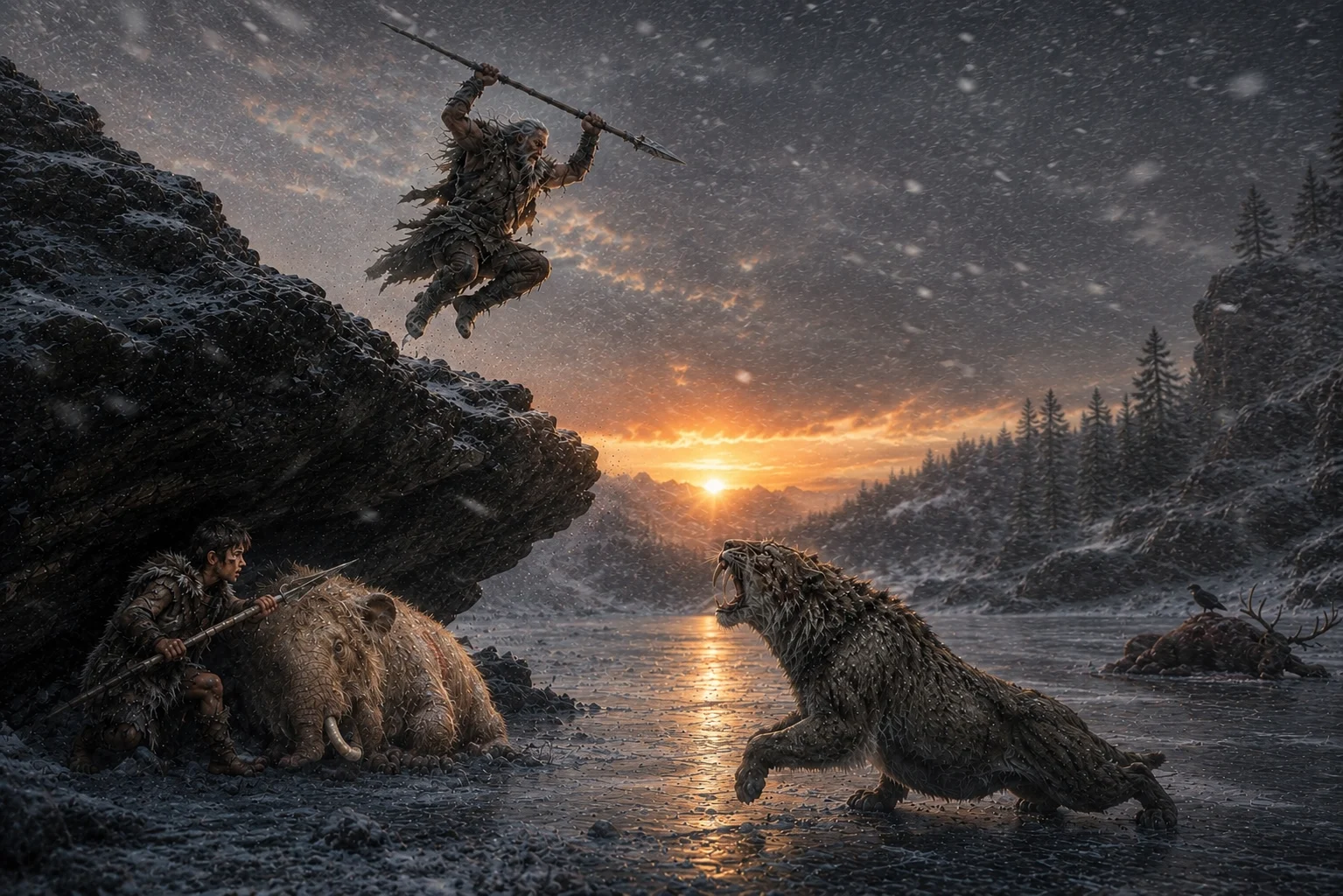
A great shape burst from the bushes. The sabertooth struck the reindeer from the side, and the animal screamed as the great cat dragged it down. The reindeer kicked once. Twice. Then it became still.
Tarek instinctively ducked behind the wall.
The cat had already made its kill. The reindeer lay dead beneath the rocks, its blood darkening the snow, and for the moment, the predator had all the food it needed. Then the wind shifted, carrying a new scent across the frozen ground and straight towards it.
The sabertooth raised its head. Its nostrils flared as it tasted the air, and somewhere beyond the rocks came the unmistakable cry of a mammoth calf.
The great cat listened and turned towards the sound.
Panic seized Tarek. He lunged forward and clamped both hands around the calf’s trunk, desperate to silence it. The calf cried out again.
Too late, he realised his mistake.
The sound came from its mouth, not its trunk.
The cat left the carcass and began moving toward the sound.
Tarek’s blood turned cold. His grip tightened around his twig spear. The yellow eyes fixed upon him. The calf stood behind him, pressed against the rock wall.
There was nowhere to run.
The sabertooth lowered its head. Its eyes were fixed on the calf.
Tarek tightened his grip on his twig spear. The twig suddenly felt very small.
The cat took another step.
Then another.
Tarek raised the spear.
The cat growled.
The sabertooth charged.
Tarek screamed and fell backwards. For a moment, he saw nothing but white.
A shadow came from the top.
Oruk.
The old hunter struck the cat across the face with the shaft of his spear.
“HEY!”
The cat stopped.
Oruk raised his spear and started shouting.
The cat lunged at Oruk.
Oruk stepped aside.
The animal’s claws tore through his hide cloak instead of his chest.
Oruk stumbled. Blood appeared beneath his ribs. He looked down. For the briefest moment, he seemed almost surprised.
The sabertooth came again.
Oruk thrust his spear.
The cat’s paw slammed against the shaft, snapping it in two and throwing Oruk sideways. He crashed hard against the frozen riverbank, while the broken spear fell across the ice.
The calf cried again.
The sabertooth turned toward the sound.
Oruk lifted his head.
The calf stood only a few paces behind Tarek.
And the cat was between them.
The old hunter tried to rise, but his leg slipped beneath him, and he fell to one knee. As the sabertooth advanced toward the calf, Oruk grabbed a stone and hurled it. It struck the animal’s flank.
The sabertooth turned.
“HERE!” Oruk shouted.
The cat charged.
Oruk barely moved in time before it struck him. They crashed into the snow and rolled together, the great cat’s weight carrying them across the frozen ground until Oruk disappeared beneath it.
“ORUK!” Tarek screamed.
The calf trumpeted.
The sound rolled across the frozen river.
The old hunter’s hand emerged from beneath the cat. He seized its fur, one hand locked around its throat, while the other searched blindly through the snow. His fingers found a stone.
He struck.
Once.
Twice.
The sabertooth twisted, and its claws tore into Oruk’s side.
Oruk cried out.
Then he locked both arms around the animal’s neck.
The cat struggled violently. Oruk’s legs dug into the snow, his body shaking with the effort. Blood spread across his hide cloak, but he held on. The sabertooth tried to rise, and Oruk dragged it back down.
The animal snarled.
Oruk’s face was pressed against its thick neck.
Then the calf cried again.
For a moment, the world became nothing but claws, snow, blood, and a deafening roar.
Oruk looked toward Tarek.
The boy stood beside the rock. His little twig spear lay in the snow between them.
Oruk’s eyes found it.
Then they found Tarek.
“Your spear!”
Tarek stared at him.
The sabertooth twisted violently. Oruk’s grip slipped, and the cat’s head swung toward Tarek. Oruk dug his fingers deeper into its fur.
“Pick it up!”
Tarek looked at the ugly little twig, the same spear the hunters had laughed at that morning.
He ran and grabbed it.
The sabertooth saw him.
It began to twist free.
Oruk was losing his grip.
The cat raised one paw, its claws flashing.
Tarek ran closer.
One claw tore across Oruk’s shoulder.
Oruk screamed.
His arms loosened.
The cat broke free.
It turned.
Tarek stopped.
The animal faced him.
It was enormous.
Its mouth opened, and its breath steamed in the freezing air.
Tarek raised the spear in trembling hands.
Behind the animal, Oruk lay on his back, blood running down his side. He turned his head and saw what was about to happen.
“Don’t throw at its head!”
Tarek looked at him.
Oruk shouted again.
“Wait until it comes!”
The sabertooth growled.
Tarek’s feet sank into the snow. He tightened his grip on the spear.
Behind him, the calf cried.
The cat took one step.
Then another.
It charged.
“NOW!”
Tarek threw.
The spear left his hand.
For one impossible moment, everything seemed to slow.
The spear crossed the space between them.
The sabertooth was already in the air.
Then the point struck.
It entered beneath the animal’s chest. The force of the charge drove the spear deeper, the stone point breaking through fur, flesh, and rib bone. The twig vanished almost entirely into its body.
The sabertooth screamed.
Its body twisted above Tarek, then crashed into the snow beside him.
The boy fell backwards.
The sabertooth rolled once.
Twice.
Then stopped.
Silence returned.
Tarek could hear only his own breathing.
Then he remembered.
“Oruk!”
He scrambled to his feet.
Oruk was still lying several paces away beside the frozen river. He had not moved.
Tarek ran toward him.
“Oruk!”
The old hunter looked at the fallen animal. Then at Tarek. Then at the spear.
A strange smile appeared on his bloodied face.
“Ugly spear.”
Tarek’s eyes filled with tears.
Oruk tried to laugh, but the laugh became a cough. He pressed one hand against his side and pulled it away, red with blood. It had soaked through his hide cloak and spread across the snow beneath him.
Tarek tried to pull him upright.
Oruk groaned.
“Wait.”
Tarek stopped.
Oruk tried to move his arm. It shifted. His shoulder moved.
But his body did not.
He frowned and tried again.
Nothing.
He pushed against the frozen ground with his elbow, but the ice held him fast.
Tarek grabbed his arm.
“I’ll pull you.”
Oruk looked down.
The fur of his blood-soaked cloak had frozen to the snow and ice beneath him.
Tarek dropped beside him and began scraping at the ice with his bare hands.
“I’ll get you out.”
“Tarek.”
The boy kept digging.
“I’ll get you out.”
“Tarek.”
“Stop saying my name!”
The old hunter watched him.
The boy’s fingers were already turning red.
Oruk reached out and caught his wrist.
“Stop.”
The ice beneath them shuddered.
Tarek looked up.
Another tremor passed through the frozen ground.
Then another.
The calf suddenly became still. Its ears lifted, and it turned toward the distant trees.
Far beyond the forest came a sound like distant thunder.
The thunder grew louder.
Through the veil of falling snow, beyond the dark pines, enormous shapes began to emerge.
The mammoths had returned.
First one.
Then three.
The mother came to the front.
She saw the calf.
The calf saw her.
The sound that came from the young mammoth was unlike anything Tarek had heard before.
It ran.
Or tried to.
Its legs stumbled beneath it. It fell, struggled upright, and fell again.
The mother reached it and curled her trunk around its body.
The calf pressed itself against her massive frame, trembling.
Tarek stood frozen.
Oruk opened his eyes. His gaze moved past Tarek, toward the mammoths and the calf.
The mother was already leading the young one back toward the herd.
Oruk smiled.
“Look.”
Tarek turned.
The calf stopped.
It looked back.
For a moment, its eyes met Tarek’s.
Then it followed its mother.
Tarek watched until they disappeared into the snowfall.
His eyes filled with tears.
Then he looked back at Oruk.
“You said we would go beyond the mountain,” Tarek said, kneeling beside him.
Oruk’s expression changed.
The smile faded.
For a moment, he simply looked at the boy.
Tarek saw fear in the old hunter’s eyes. Not fear of the sabertooth. Not fear of death. Something quieter. He had seen it before, in the moment before Oruk had left the camp. The fear of leaving something unfinished.
The wind moved across the frozen river.
Snow began to settle on Oruk’s shoulders.
Tarek started scraping at the ice again.
“We have to go back,” he said.
Oruk opened one eye.
“Where?”
“Home.”
“Ah.”
Oruk smiled faintly, as though the answer had genuinely surprised him.
Then he laughed.
The laugh became a bloody cough.
Tarek stopped digging and gripped his hand.
“Don’t be afraid,” he whispered. “I’ll take you home.”
Oruk looked at him.
Then, slowly, he smiled, “You sound like me.”
The storm had begun to clear, and the eastern mountains emerged from the clouds. But, they looked impossibly far away, despite the distance they had covered.
“Then you can come with me.”
Oruk looked east.
“Beyond the mountain,” Tarek whispered.
Oruk’s eyes remained fixed upon the distant peaks.
Tarek waited.
The wind moved over the ice. Snow settled on Oruk’s hair.
“Oruk?”
No answer.
Tarek waited a little longer.
“We will go tomorrow.”
Still nothing.
The boy squeezed his hand.
“Tomorrow, then.”
The hand did not move.
Tarek looked toward the mountains. He watched until they disappeared behind another veil of snow. Above them, the sun climbed slowly over the mountains, turning the frozen river into a long ribbon of pale fire.
The hunting party found them before sunset.
They followed the trail along the frozen river, expecting to find Tarek and Oruk.
One of the hunters stopped.
Ahead, beneath the shadow of the rocks, sat Tarek.
Alive.
The boy did not hear them approach. He was covered in dried blood, though most of it was not his own. His hands were wrapped around the broken shaft of Oruk’s spear.
One of the hunters knelt before him.
“Tarek.”
The boy looked up.
For a moment, he seemed almost confused to see another human face.
Then his mouth trembled.
The hunter pulled him into his arms.
Tarek did not resist.
He simply let himself be carried.
One followed the blood trail toward the river.
They found the sabertooth first.
It lay half-buried in the snow near the riverbank, its great body twisted where it had fallen. Oruk’s spear had pierced deep through its chest. Blood had frozen black around the wound, and the cat’s jaws were still open, its long teeth exposed against the snow.
A few paces away lay the reindeer, partly covered by drifting snow,
The others gathered around Oruk.
The old hunter lay beneath the rock where the frost had taken hold of him. His wounds had stopped bleeding. His body was cold and stiff, one hand still curled as though it had been gripping something.
One of the hunters looked at the dead cat. Another looked at Oruk.
“He killed it?”
Tarek shook his head.
His voice was barely audible.
“I did.”
The hunters turned toward him.
Tarek looked down at the broken spear in his hands.
“He held it.”
No one said anything more. They understood.
They salvaged the reindeer first. The meat was precious. It would be carried home before the cold could claim it. The hide was stripped carefully. The bones were gathered. Nothing useful was left behind.
Then they turned to the sabertooth.
It was a dangerous animal even in death. They approached cautiously, keeping their spears ready as though the great cat might suddenly rise again.
Its hide would make warm coverings. Its bones could be shaped into tools. Its claws could become ornaments or hunting charms.
And its teeth… Its teeth would outlive the flesh that had carried them.
One of the hunters touched a long canine with the tip of his spear.
“These will be stories.”
Tarek looked at him.
The hunter glanced toward Oruk, “So will he.”
They worked until the fading light forced them to stop.
Before leaving the place, Tarek looked once more toward the frozen river.
The mammoths were gone. The calf was gone. The sabertooth was gone. What remained of them was already filled by the wind and snow.
The hunting party began the journey home. But he kept looking east.
The mountains were still there. They had not moved. They had not answered either.
Somewhere beyond them, the cranes were already flying.
He watched until they disappeared.
Then he turned toward home.
For now.
© 2026 Dr. D
© 2026 Dr. D
© 2026 Dr. D
© 2026 Dr. D
© 2026 Dr. D
Thank you for your comment!
Comments